

JAKARTA—The Flat and Safety Glass Association (AKLP) is urging state-owned enterprises to conduct a comprehensive analysis of the planned import of CBU pickup trucks. AKLP Chairman Yustinus H Gunawan, in a statement in Jakarta on Friday, 20 February 2026, stated that the plan to import of 105,000 pickup trucks needs to be reviewed, taking into account the structure and capacity of the domestic industry to avoid stifling utilization in the related sector.
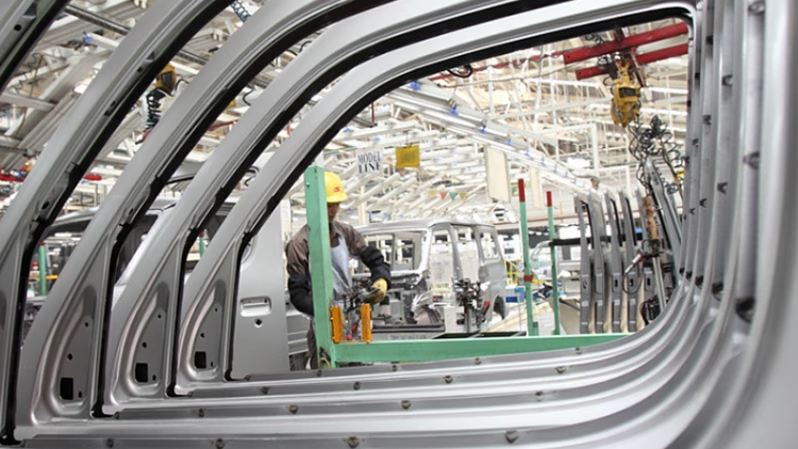
He explained that the national flat glass industry currently has an installed capacity of 2.9 million tons per year. Production is operated by four companies, with a production utilization rate of 66.9 percent in 2025. Meanwhile, in the downstream sector, there are 10 automotive safety glass companies with an installed capacity of 90,293 tons per year, equivalent to 2.25 million sets of safety glass for four-wheeled vehicles or more, with a utilization rate of 42 percent.
According to him, this situation indicates that national production capacity still has significant room for optimization, especially given the annual production capacity of four-wheeled or more motorized vehicles (motor vehicle industry) of 2.59 million units. Domestic flat glass is a primary input for automotive safety glass production, so domestic vehicle demand is directly linked to the performance of the upstream and downstream glass industry sectors.
In this context, the policy of importing 105,000 CBU vehicles is estimated to reduce safety glass demand by approximately 10 percent, contributing to domestic motor vehicle production, aiming to achieve the production target of 1 million units by 2026. In terms of regulations, the national automotive safety glass industry has complied with the Indonesian National Standard (SNI) 8210:2018, which is mandated by the Minister of Industry Regulation (Permenperin) Number 15 of 2025.
Vehicle safety glass products also have a Domestic Component Level (TKDN) certificate with an average value above 50 percent, reflecting a contribution to domestic added value and strengthening the national industrial structure. Furthermore, the quality of national safety glass has been recognized globally, as reflected in the export of CBU vehicles and spare parts using domestically produced components.
If imports are still necessary to meet market needs or for specific reasons, an approach considered more aligned with strengthening the domestic industry is the incomplete knockdown (IKD) scheme. This scheme allows for the import of components that are not yet produced or are not yet sufficiently competitive domestically, while maintaining assembly activities and the use of locally available components, including domestic automotive safety glass.
Therefore, a selectively designed import policy based on industrial capacity is considered more effective in maintaining the sustainability of the flat glass and automotive safety glass sectors. This also supports increased added value and sustainable national industrialization.
Minister of Industry Agus Gumiwang Kartasasmita emphasized that Indonesia’s ability to independently produce pick-up trucks demonstrates the independence of the national automotive industry and provides significant added economic value to the economy. He made this response in relation to the planned import of 105,000 pick-up trucks from India for the Merah Putih Village Cooperative (KDMP).
In a statement in Jakarta on Thursday, 19 February 2026, the Minister of Industry explained that if the procurement of 70,000 4×2 pickup trucks is met from domestic production, it will have a backward economic linkage of around Rp 27 trillion. (ANTARA)