

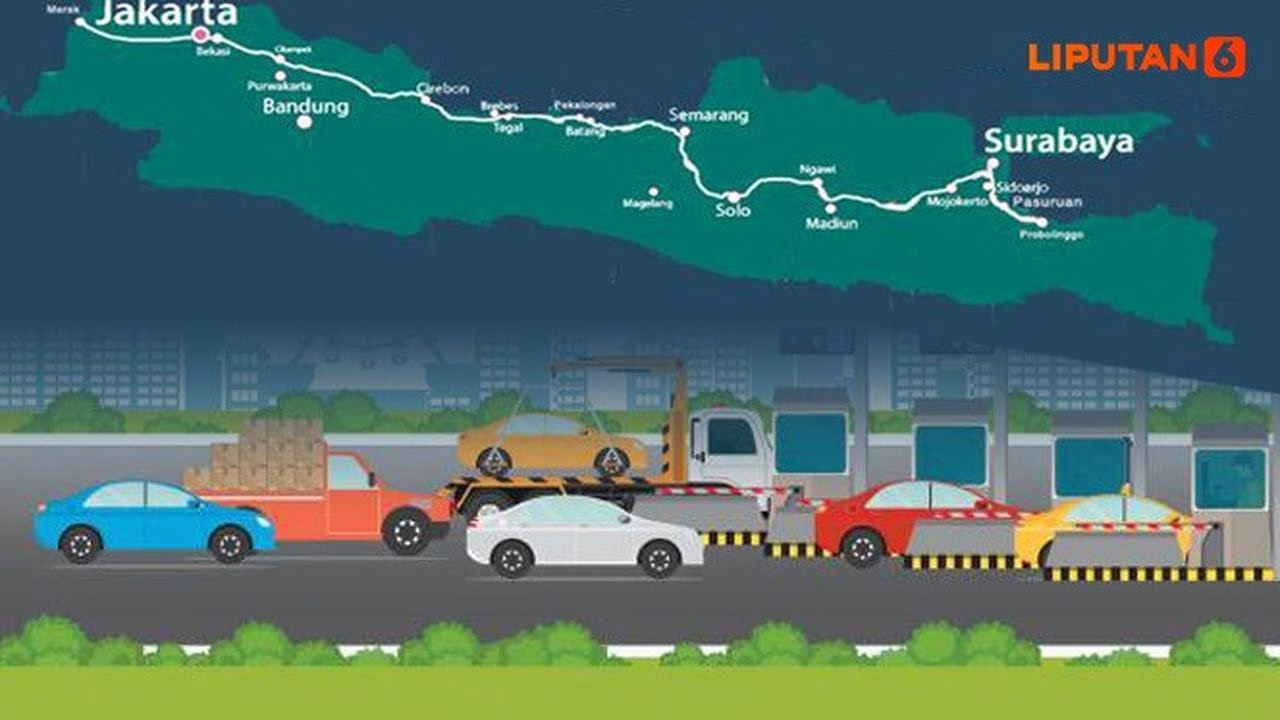
JAKARTA— PT Jasa Marga (Persero) Tbk projects that 3.6 million vehicles will leave the Jakarta, Bogor, Depok, Tangerang, and Bekasi (Jabodetabek) area via toll roads during the 2026 Eid al-Fitr homecoming season. This surge in traffic is predicted to be divided into three main directions: east towards the Trans Java Toll Road and Bandung, west (Merak/ Banten), and south (Bogor and Ciawi/ West Java).
Jasa Marga President Director Rivan A Purwantono stated that Jasa Marga has prepared several anticipatory measures based on historical data and projections for the Eid holiday period. Approximately 50 percent of vehicles will travel eastward. 28 percent will head west or towards Merak, and around 20.7 percent will head south via Ciawi.
The eastbound traffic will split at the Cikampek Utama Toll Gate. From this point, vehicles will split into two—continuing east towards the Trans Java Toll Road (57 percent) and turning south towards Bandung (42 percent). With this composition, the Trans Java route has the potential to be the most congested point during the peak Eid al-Fitr exodus in 2026.
Congestion and SPKLU Monitoring via Mobile
Jasa Marga is not only relying on traffic engineering, but is also optimizing the digitalization of its toll transaction services. Through the Travoy app, the company targets 700 non-stop toll gates to serve road users throughout 2026. “Currently, there are 97 non-stop gates in Jakarta, and this year we will add 700 more non-stop gates,” said Rivan.
This tapless electronic payment system utilizes Radio Frequency Identification (RFID) sticker technology. With this system, drivers simply need to travel at a speed of around 20 kilometers (km) per hour when passing through a special gate with the Travoy Go logo.
Without the need to stop or tap a card, the gate will open automatically thanks to RFID identification integrated with the Travoy app. The Travoy app also features real-time traffic monitoring. Congestion data is obtained through radar and approximately 3,500 cameras installed on various toll roads. Users can view live traffic conditions, including whether there is congestion on specific sections.
Furthermore, information on rest areas and the location of the nearest Public Electric Vehicle Charging Stations (SPKLU) is also available in the app. This feature is certainly crucial, especially for travelers heading home using electric vehicles who need to plan charging times during long-distance trips. “The validation is precisely when viewed live. And this also allows us to see whether or not congestion is experienced on all sections,” said Rivan.
With a projected 3.6 million vehicles and a predominance of eastbound traffic, the 2026 Eid homecoming is certain to once again be a crucial time for toll road operators and travelers. Optimizing technology such as stop-free gates and real-time monitoring is expected to reduce congestion and improve travel comfort. (LIPUTAN 6)