

JAKARTA— The Ministry of Industry (Kemenperin) has urged the Association of Indonesian Automotive Industries (GAIKINDO) and related industries to immediately prepare concrete proposals regarding the Luxury Goods Sales Tax (PPnBM) scheme for motor vehicles, particularly commercial vehicles. This was conveyed by Andi Komara, Coordinator of the Directorate of Maritime Industry, Transportation Equipment, and Defense Equipment (IMATAP) at the Ministry of Industry. He made this statement at the GAIKINDO Indonesia International Commercial Vehicle Expo (GIICOMVEC) 2026 exhibition at JIExpo Kemayoran, Jakarta, on Thursday, 9 April 2026.
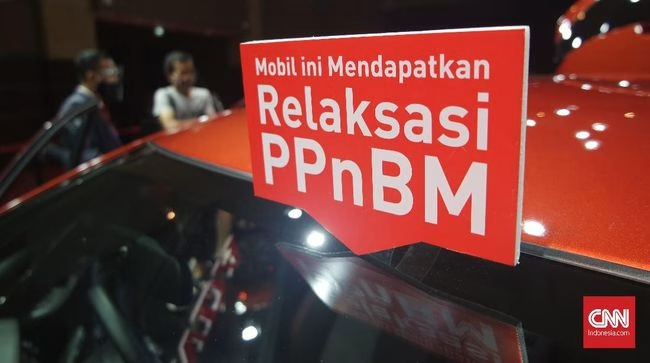
This step relates to the planned revision in 2031 of Government Regulation (PP) Number 73 of 2019, which was amended by PP Number 74 of 2021. “While this will be revised in 2031, GAIKINDO, the industry, and relevant stakeholders should prepare studies or simulations so that when the Ministry of Finance makes this revision, the industry will automatically have prepared proposals regarding taxation,” he said.
Andi believes that this momentum should be utilized by the industry to influence the direction of tax policy to favour strengthening the domestic industry. One option that has emerged is adjusting the PPnBM rate for commercial vehicles, specifically by differentiating treatment between local and imported products.
Andi proposed that domestically produced trucks retain a zero percent incentive, while imports could be subject to a higher tariff as an instrument of industry protection. “For domestic trucks, we’re exercising a PPnBM (Luxury Sales Tax) of perhaps zero percent. Meanwhile, for imported trucks, the PPnBM could be 30, 40, or even 50 percent. This is our simulation, so if we exercise it, it will only approach the price when imported trucks are subject to a 50 percent PPnBM,” said Andi.
Without fiscal intervention, Andi believes this disparity could hamper the competitiveness of domestic products. Currently, the PPnBM scheme is based on carbon emissions, fuel consumption, and vehicle type. The Ministry of Industry is open to changing the parameters and tariff amounts in future revisions, so that the policy functions not only as an emission control measure but also as an instrument for national industrial development.
Through this step, the government hopes that synergy between regulators and industry players will produce a more adaptive and competitive tax policy and encourage growth in the domestic automotive sector. (ANTARA)